Why Baccarat Tie Bets Offer Some of the Worst Odds in the Casino
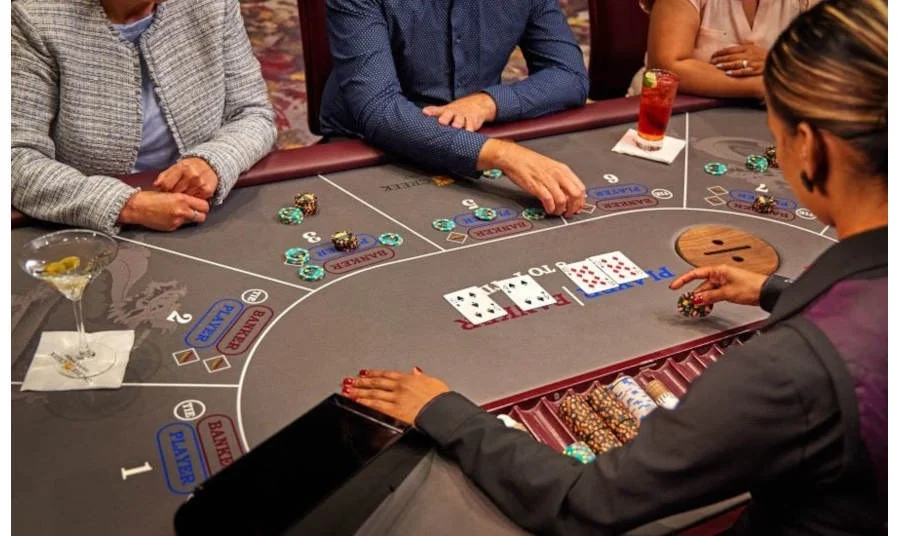
Baccarat enjoys an elite reputation across gaming floors worldwide. Long associated with velvet ropes, tuxedoed dealers, and high-stakes private salons from Macau to Las Vegas, the game draws discerning gamblers largely because of its exceptional mathematical fairness. At a standard table, betting on the Banker or the Player gives the house one of the slimmest statistical advantages in modern gambling. It is one of the rare table games where an unstudied novice can sit down, place chips on the primary wagers, and face odds comparable to disciplined blackjack or craps play.
Yet right in the center of that same elegant felt lies one of the most predatory wagers in the gaming industry: the Tie bet.
While the primary game offers player-friendly house margins hovering around one percent, the Tie bet reverses that dynamic entirely. It transforms a refined game of near-even probability into an aggressive drain on your capital. Understanding why this wager is so detrimental requires unpacking its deceptive payoff structure, the cold reality of combinatorial math, the psychological tricks embedded in modern table displays, and the rapid erosion it inflicts on an otherwise healthy bankroll.
The Seductive Allure of the Long Payout
To understand why players continually make the Tie wager, you have to look at the emotional rhythm of standard baccarat. The base game is a methodical, even-money grind. Wagering on the Player yields a 1:1 return; wagering on the Banker yields the same, minus a standard five percent house commission on winning hands. For many recreational bettors accustomed to the fast thrills of roulette numbers or slot machines, churning through dozens of hands for flat, one-unit payouts can quickly feel monotonous.
The Tie bet exploits this craving for leverage. With a standard payout of 8 to 1—and occasionally 9 to 1 in promotional settings—the wager promises immediate, outsized gratification. Turning a twenty-five-dollar chip into two hundred dollars on a single two-card draw provides an instant dopamine spike that normal gameplay cannot match.
This payout structure creates a cognitive bias known to behavioral economists as longshot bias. Bettors overweight the desirability of an elevated payout while subconsciously minimizing how rarely the underlying outcome actually occurs. The casino willingly pays eight units of profit precisely because the true odds of both sides finishing with identical point totals are far longer than the payout reflects.
The Mathematical Breakdown: An 8-Deck Reality
Baccarat is dealt from a shoe, typically containing eight standard decks of 52 cards. Every card value is fixed, and the dealing procedures for both the Player and Banker hands are governed by strict, unalterable tableau rules. Because there is no human decision-making involved in taking a hit or standing, the probability of every possible hand combination can be calculated with exact mathematical certainty.
In an eight-deck shoe containing 416 cards, there are roughly 4.998 trillion unique ways to distribute the cards into completed baccarat hands. When you aggregate all possible outcomes across the shoe, the frequency distribution settles into clear baseline probabilities:
-
The Banker hand wins approximately 45.86 percent of the time.
-
The Player hand wins approximately 44.62 percent of the time.
-
Both hands end in a Tie approximately 9.52 percent of the time.
A tie happens slightly less than once in every ten and a half hands. If the casino offered fair, zero-margin odds on this outcome, a winning Tie bet would pay approximately 9.51 to 1. Instead, the standard table pays only 8 to 1.
Calculating the House Edge
The difference between true mathematical probability and the payout price represents the house edge. When you run the expected value equation on an 8 to 1 payout across an eight-deck shoe, the result is staggering:
The house edge on the standard 8 to 1 Tie bet is 14.36 percent.
To put that number in perspective, for every one hundred dollars wagered on the Tie over time, the player can expect to surrender $14.36 to the house. By comparison, look at the house edge on the two primary wagers:
-
Banker Bet: 1.06 percent
-
Player Bet: 1.24 percent
When you move your chips from the Banker box to the Tie line, you are willingly subjecting your money to a house advantage that is more than thirteen times higher. You have left the realm of smart, low-margin table games and entered territory that rivals the worst lottery terminals on the casino floor.
What About the 9 to 1 Payout?
Some casinos, particularly in highly competitive markets or online environments, attempt to entice players by offering an upgraded 9 to 1 payout on the Tie. While this adjustment cuts into the casino’s margin, it remains an objectively poor wager.
At 9 to 1, the house edge drops to 4.84 percent. While undeniably better than 14.36 percent, it is still more than four times worse than betting on the Player and nearly five times worse than betting on the Banker. Even under the best available retail rules, the Tie remains the worst option on the baccarat felt.
How the Tie Compares Across the Casino Floor
Many players do not realize just how terrible a 14.36 percent house edge is because they lack cross-game context. A common misconception is that all table games carry roughly similar structural margins.
To see how predatory the Tie bet truly is, consider how it stacks up against other notorious wagers across the casino floor:
-
Blackjack: Basic strategy executed on a standard six-deck shoe yields a house edge of roughly 0.50 percent.
-
Craps Pass Line: Backing the shooter on the Pass Line carries a house edge of 1.41 percent, which drops below one percent once free odds are taken behind the line.
-
European Roulette (Single Zero): The house edge on every standard inside and outside wager is 2.70 percent.
-
American Roulette (Double Zero): Widely criticized by gaming analysts for its harsh math, the double-zero wheel carries a house edge of 5.26 percent.
-
Triple-Zero Roulette: Frequently mocked as an unplayable cash grab, the triple-zero wheel carries a house edge of 7.69 percent.
-
Blackjack Insurance: Often labeled a classic sucker bet by card counters and analysts, insurance against a dealer ace carries a house edge of roughly 7.40 percent.
The standard baccarat Tie bet, at 14.36 percent, is nearly double the house edge of triple-zero roulette and almost twice as damaging as taking blackjack insurance. It essentially takes a high-margin carnival novelty wager and disguises it inside one of the most sophisticated card games ever created.
The Psychological Mirage of Electronic Scoreboards
Walk by any modern baccarat table, and you will see a towering, multicolored electronic display board standing beside the dealer. These screens track the historical results of the current shoe using traditional Chinese recording systems: the Bead Plate, the Big Road, the Big Eye Boy, the Small Road, and the Cockroach Pig.
Ties are typically indicated on these displays with bright green slashes or dots superimposed over red (Banker) and blue (Player) circles. These displays are not provided as a courtesy to help you beat the game; they are sophisticated marketing instruments designed to trigger the gambler’s fallacy.
Players glance at the board and start constructing narratives out of random statistical noise:
-
If forty hands have passed without a green slash, players convince themselves that a tie is overdue, leading them to ramp up their unit size on the Tie box.
-
If two ties occur in close proximity, players assume the shoe has become choppy or clustered, wagering on consecutive ties under the impression that momentum is at play.
Both assumptions are completely false. Baccarat hands are independent trials governed by standard sampling without replacement. While the composition of the shoe changes marginally as cards are discarded into the drop box, the shift in tie probability from hand to hand is minuscule. The presence or absence of a green slash on the electronic display provides zero predictive value regarding whether the next hand will yield equal totals. Trusting the board simply feeds more chips into a 14-percent meat grinder.
The Fallacy of the Tie as a “Hedge”
Another persistent myth among recreational gamblers is that the Tie bet functions as a form of insurance or a protective hedge for a primary Banker or Player position.
A bettor might place one hundred dollars on the Banker and throw ten dollars on the Tie, reasoning that if the hands dead-heat, the eighty-dollar win on the Tie will offset an annoying stalemate or generate bonus profit.
This thinking fundamentally misunderstands how baccarat rules treat ties:
If you bet on the Banker or Player and the hand ends in a tie, your original bet is a push.
Your money is not lost; it is simply returned to you in full. You do not need to insure a push. When a tie occurs, the casino hands your main wager back without penalty. By placing a simultaneous wager on the Tie, you are not protecting your capital; you are taking a portion of your bankroll and exposing it to an astronomical house advantage on an outcome that already carries zero downside for your primary bet. Hedging a wager that cannot lose money on that specific outcome is an exercise in burning capital.
The Compounding Damage of High-Frequency Churn
The devastating nature of the Tie bet becomes obvious when you factor in game velocity. Baccarat, particularly in its mini-baccarat format where the dealer handles all the cards and players never touch the deck, is exceptionally fast. A brisk dealer can easily run through 60 to 80 hands per hour.
To visualize the real-world financial damage, imagine a recreational player wagering $25 per hand over a four-hour session, averaging 70 hands per hour. That amounts to 280 hands and $7,000 in total gross wagering action.
-
Scenario A: Sticking Exclusively to the BankerAt a 1.06 percent house edge, the player’s theoretical loss across that $7,000 in action is approximately $74.20. It is a manageable cost of entertainment, easily overcome by a minor positive variance swing.
-
Scenario B: Splitting Action with the TieNow imagine that same bettor places $20 on the Banker and $5 on the Tie every single hand. Over the same 280 hands, they put $5,600 through the Banker box and $1,400 through the Tie box.
-
Theoretical loss on the Banker action: $59.36
-
Theoretical loss on the Tie action: $201.04
-
Total combined theoretical loss: $260.40
-
By diverting just one-fifth of each wager onto the Tie, the player increases their expected loss by more than 250 percent. The Tie bet acts as an invisible leak in the hull of a ship, quietly siphoning away bankroll reserves regardless of how well the player guesses on the main Banker and Player decisions.
Can Card Counting Beat the Tie Bet?
Given that baccarat is dealt from a shoe without replacement, experienced advantage players have spent decades running computer simulations to determine whether card counting can overcome the massive house edge on the Tie.
The logic seems sound on the surface: ties occur most frequently when the shoe is rich in paired cards or zero-value cards (tens, jacks, queens, kings) that make matching totals easier to assemble. In theory, if a counter tracks the depletion of specific denominations, a positive expectation threshold might emerge.
While mathematical models prove that an edge is theoretically possible late in a shoe under specific deck depletion scenarios, the practical application is completely unviable for human play:
-
Extreme Infrequency: Positive expectation situations on the Tie bet occur in less than one percent of all dealt shoes.
-
Deep Penetration Required: An edge only develops when the dealer cuts the shoe extraordinarily deep, leaving fewer than one or two decks behind—a dealing procedure that modern casino management deliberately prevents.
-
Microscopic Advantage: When a positive count does materialize, the player’s statistical edge is typically razor-thin, often under one percent, while requiring huge swings in unit sizing that instantly trigger surveillance scrutiny.
For all practical purposes, the baccarat Tie bet cannot be beaten through card counting. It remains an insurmountable mathematical wall from the first shuffle to the plastic cut card.
Playing Baccarat the Intelligent Way
Baccarat remains one of the finest games in any casino, provided you respect its core structure. It offers low volatility, stress-free dealing mechanics, and an exceptionally fair playing field when you restrict your action to the primary options.
The strategy for playing optimal baccarat requires no complex flowcharts or memorized indices. It requires only three simple habits:
-
Bet the Banker: It has the lowest mathematical house edge on the table at 1.06 percent, making it your best statistical shot at preserving your bankroll over extended play.
-
Bet the Player Occasionally: At 1.24 percent, the Player bet is nearly as favorable as the Banker and eliminates the need to track or pay commissions.
-
Completely Ignore the Tie Box: Treat the Tie line as if it does not exist on the layout.
The glossy 8 to 1 payout is nothing more than a carefully designed tax on boredom and impatience.Leaving your chips off the Tie keeps the odds where they belong—firmly anchored to one of the narrowest house advantages in the entire gambling world.